Grip strength is the amount of force your hands and forearms produce to close around an object or hold it in place. In a clinic or gym, we look at the hands first because they are the final contact point between your skeleton and the outside world. If the hands cannot hold a load, the shoulders and spine never receive the training signal, regardless of how strong the legs or hips are.
Public health researchers track grip strength because it reflects systemic muscular health, biological aging, and nervous system integrity. Low grip force often tracks with lost muscle tissue throughout the body, slower walking speed, and longer hospital stays after illness. Measuring your grip gives you an objective number that tracks physical decline or physical progress over months and years.
Why forearm tension correlates with general physical capability
When you close your hand with maximum effort, the contraction does not stay in your fingers. The muscular impulse travels up the kinetic chain through a process called neuromuscular irradiation. Squeezing your fist recruits the flexor muscles in your forearm, which triggers co-contraction in the biceps, triceps, and the rotator cuff muscles around the shoulder joint. A firm grip stabilizes the shoulder socket before the upper arm moves.
Grip tests also serve as an external proxy for total muscle mass. Skeletal muscle requires dietary protein, regular resistance stress, and neurological drive to remain dense. Because the hands and forearms are used in nearly every physical task, they show disuse rapidly. When someone loses total body muscle mass due to inactivity, malnutrition, or aging, the hand muscles lose contractile tissue at a measurable rate.
Central nervous system fatigue also appears clearly in hand output. The brain must send high-frequency electrical signals to recruit the small motor units of the hand. If your nervous system is run down from sleep loss, excessive training volume, or illness, your hand output drops by several kilograms before your larger muscles feel tired. For this reason, coaches and clinicians use daily or weekly grip tests to check systemic recovery.
How to use a hand dynamometer correctly
The standard tool for testing grip force is the hydraulic hand dynamometer. The Jamar design is the clinical benchmark, though calibrated digital load-cell dynamometers work well for personal tracking. Testing requires a standard position so that changes in posture do not alter your results.
- Adjust the handle to the second notch from the inside. This position fits most adult hands by allowing the middle phalanges to sit flat against the front bar while the palm rests on the rear bar.
- Sit upright in a chair without armrests. Keep your feet flat on the floor, your shoulders relaxed, and your chest open.
- Place the elbow of your testing arm at your side, bent to a 90-degree angle. Keep your forearm in a neutral position with your thumb pointing upward. Do not rest your forearm on your leg or a table.
- Exhale and squeeze the handle with maximum effort for three seconds. Do not jerk your body, bend your wrist, or swing your arm.
- Record the peak force in kilograms. Rest for 60 seconds, then repeat the test on the opposite hand.
Complete three trials per hand, alternating sides. Take the average of the three trials for your score. Healthy adult men between 25 and 45 years old typically produce between 42 and 54 kilograms of force on their dominant hand. Healthy adult women in the same age band typically produce between 26 and 36 kilograms. A difference greater than 15 percent between your dominant and non-dominant hand warrants closer attention to joint mechanics or nerve impingement. If you experience sharp pain in the carpal bones or wrist during testing, stop and consult a physical therapist or physician.
Crush grip versus pinch grip mechanics
Hand strength is not a single capacity. The hand applies force in different directions depending on the task. The two primary categories in strength training are crush grip and pinch grip.
Crush grip occurs when your fingers close against your palm, wrapping around an object such as a barbell, a dumbbell, or a suitcase handle. This movement relies on the extrinsic finger flexors, primarily the flexor digitorum profundus and flexor digitorum superficialis, located in the deep anterior compartment of your forearm. Crush grip allows you to move heavy loads because the fingers lock around the object, transferring load directly into the palm and skeletal structure of the arm.
Pinch grip occurs when your fingers squeeze against your opposing thumb without the object touching your palm. This movement relies heavily on the thumb muscles, including the flexor pollicis longus and the adductor pollicis, along with the intrinsic lumbricals and interossei of the hand. Pinch grip generates lower absolute force than crush grip because the thumb must balance the opposing force of two to four fingers. However, it builds higher joint stability across the carpal bones and strengthens the thumb pad, which protects the wrist during rotational sports and manual work.
| Factor | Crush Grip | Pinch Grip |
|---|---|---|
| Primary Hand Contact | Fingers closing against palm | Fingertips opposing thumb pad |
| Main Muscles Used | Flexor digitorum profundus and superficialis | Flexor pollicis longus, adductor pollicis, lumbricals |
| Common Training Tools | Barbells, thick bars, torsion spring grippers | Weight plates, pinch blocks, smooth timber blocks |
| Force Output Range | High (30 to 70+ kg in trained adults) | Moderate (8 to 25 kg in trained adults) |
| Primary Failure Point | Finger uncurling along the bar | Thumb slip or thumb base fatigue |
Dead hangs and farmer walks for tendon resilience
Muscles adapt to training in weeks, but the tendons and connective pulleys of the fingers adapt over months. The flexor tendons slide through dense fibrous sheaths called annular pulleys (labeled A1 through A5). Overloading these structures with fast, dynamic jerking causes tears. Sustained isometric holds, such as dead hangs and farmer walks, apply continuous, steady fluid pressure to the tendons. This tension stimulates collagen synthesis and thickens the connective tissue without wearing out the finger joints.
Dead hangs
A dead hang trains isometric finger flexion while opening the shoulder joint under traction. Use a standard pull-up bar with a diameter between 28 and 32 millimeters.
- Take an overhand grip with your hands spaced shoulder-width apart. Wrap your thumbs around the bar.
- Step off the box or bench smoothly. Do not drop into the hang from a jump.
- Perform an active hang: pull your shoulder blades down slightly away from your ears, brace your abdominal muscles, and keep your legs straight.
- Hold for 20 to 45 seconds per set. If you cannot reach 20 seconds, keep your toes resting lightly on a box to remove 10 to 20 kilograms of your body weight.
- Perform 3 to 4 sets, resting 90 seconds between sets.
Farmer walks
The farmer walk combines crushing grip demands with gait mechanics. As you step, your body shifts from side to side, which forces your fingers and wrist flexors to fight the swinging inertia of the weights.
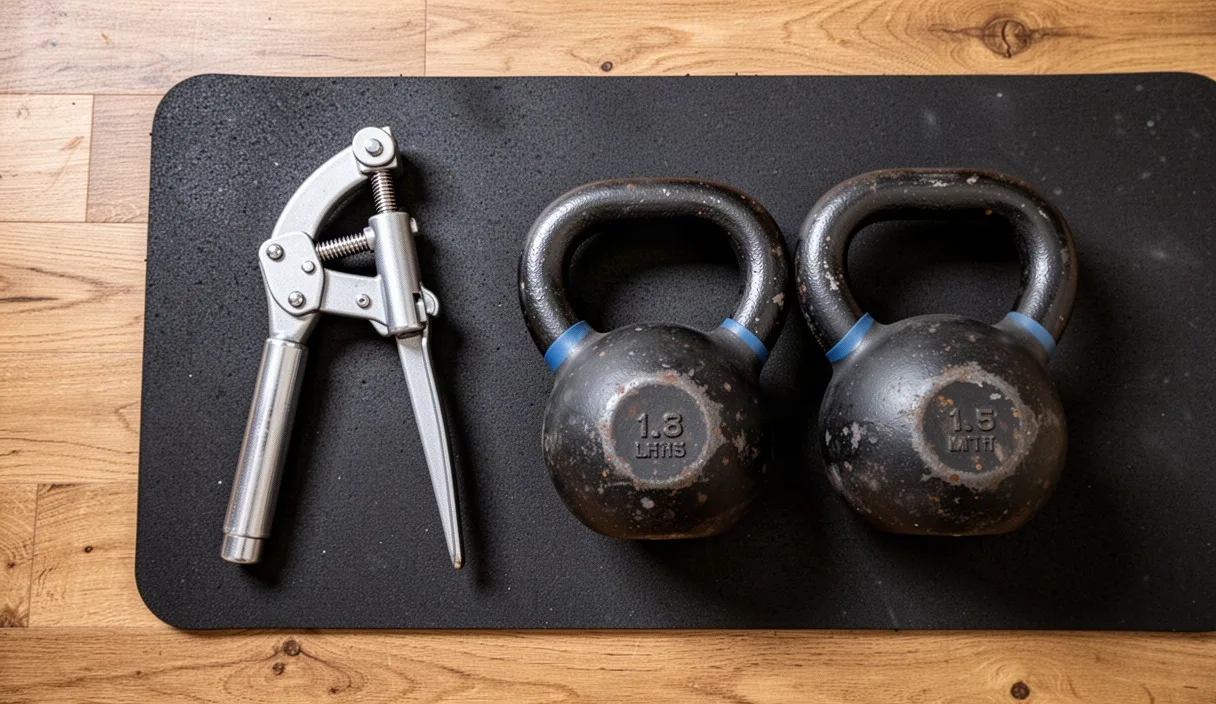
- Pick up two heavy dumbbells, kettlebells, or farmer walk handles. For an intermediate lifter, a starting weight is roughly 25 to 35 kilograms per hand for men, and 16 to 24 kilograms per hand for women.
- Stand tall with your ribs pulled down, shoulders set back, and eyes on the horizon. Do not let the weights rest against the sides of your thighs.
- Walk in a straight line for 30 meters using short, controlled heel-to-toe steps. Breathe continuously through your nose.
- Lower the weights to the floor under control by bending at your hips and knees. Never drop the weights while standing.
- Complete 3 to 5 trips, resting 2 minutes between trips.
Programming grip work at the end of training days
Never train your grip before your main compound lifts. If you exhaust your forearms with pinch blocks or hangs before performing deadlifts, rows, or pull-ups, your hands will fail before your back and leg muscles reach their training threshold. This limits your systemic strength gains and increases the risk of dropping a barbell.
Place direct grip training at the very end of your training session, two or three days per week. Spread the work across different grip types so you do not overuse a single tendon path. A standard training week should balance crush work, pinch work, and wrist extension balance.
Here is an example structure to run over an eight-week cycle:
- Monday (Crush Focus): Active bar dead hangs. 3 sets of maximum duration (stop 3 seconds before grip opens). Rest 90 seconds. Finish with 2 sets of high-repetition wrist curls using a light barbell for 15 repetitions.
- Wednesday (Pinch Focus): Two-handed plate pinch (holding two smooth 5-kilogram plates together smooth side out, or a dedicated pinch block). 4 sets of 15-second holds per hand. Rest 60 seconds between sides.
- Friday (Dynamic Carry Focus): Farmer walks. 4 rounds of 30 meters with heavy dumbbells. Rest 2 minutes between rounds.
Do not add grip volume indefinitely. Six to eight hard work sets per week are enough to build forearm density and increase dynamometer scores. When you can complete a dead hang for 60 continuous seconds with bodyweight, add a dip belt with 5 kilograms rather than hanging for two minutes. Progressive resistance works better than infinite endurance for building tendon thickness.
Common mistakes
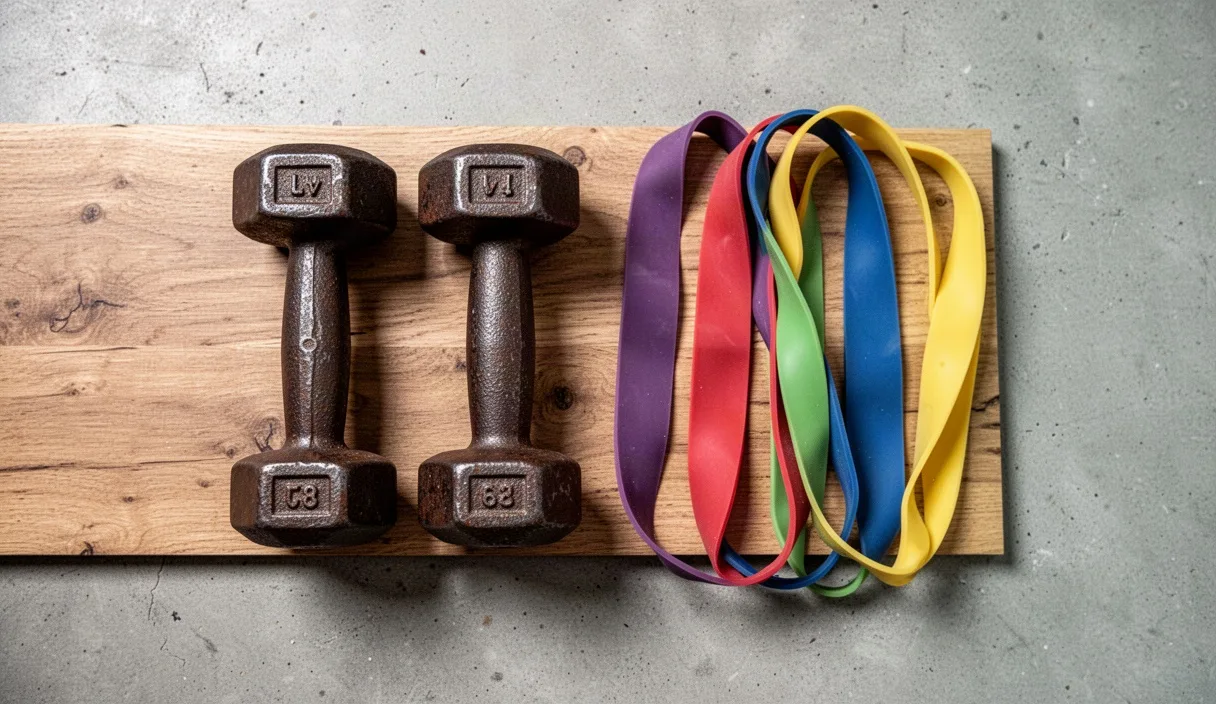
- Neglecting finger extensors: Lifters often train only the closing muscles. The extensor digitorum muscles on the top of the forearm open the fingers. If the flexors become drastically stronger than the extensors, you can develop lateral epicondylalgia, commonly called tennis elbow. Counteract this by wrapping a thick rubber band around your closed fingertips and opening your hand against the tension for 25 repetitions twice a week.
- Relying on lifting straps for light sets: Using straps on warm-up sets removes the natural volume your hands need. Do not use straps on deadlifts or pull-ups until your grip is the genuine limiting factor on your final, heaviest sets.
- Bending the wrist during carries: Letting your wrist collapse into extension during a heavy carry places shearing stress across the carpal tunnel and flexor retinaculum. Keep your wrist completely straight, aligned with your forearm, for the entire duration of the walk.
- Increasing volume too quickly: Tendons receive less blood supply than muscle bellies. If you increase grip training volume or weight by more than 10 percent in a single week, you risk developing tendon sheath inflammation. Progress loads slowly over months.
Practical next steps
Begin by securing a baseline measurement. If you have access to a dynamometer at a gym or clinic, run the three-trial test described above and log your numbers. If you do not have a dynamometer, time a bodyweight dead hang on a standard pull-up bar until your hands open. Note that time in your training log.
Choose two grip drills: one hang or carry variation, and one pinch variation. Add them to the end of your workouts twice per week for six weeks. Re-test your baseline on week seven under the same conditions, at the same time of day. If you track an increase of 3 to 5 kilograms on a dynamometer, or 15 seconds on a hang test, your training stimulus is working. If your score stays flat or drops, lower your training volume, review your sleep, and ensure you are eating enough protein to support connective tissue remodeling.