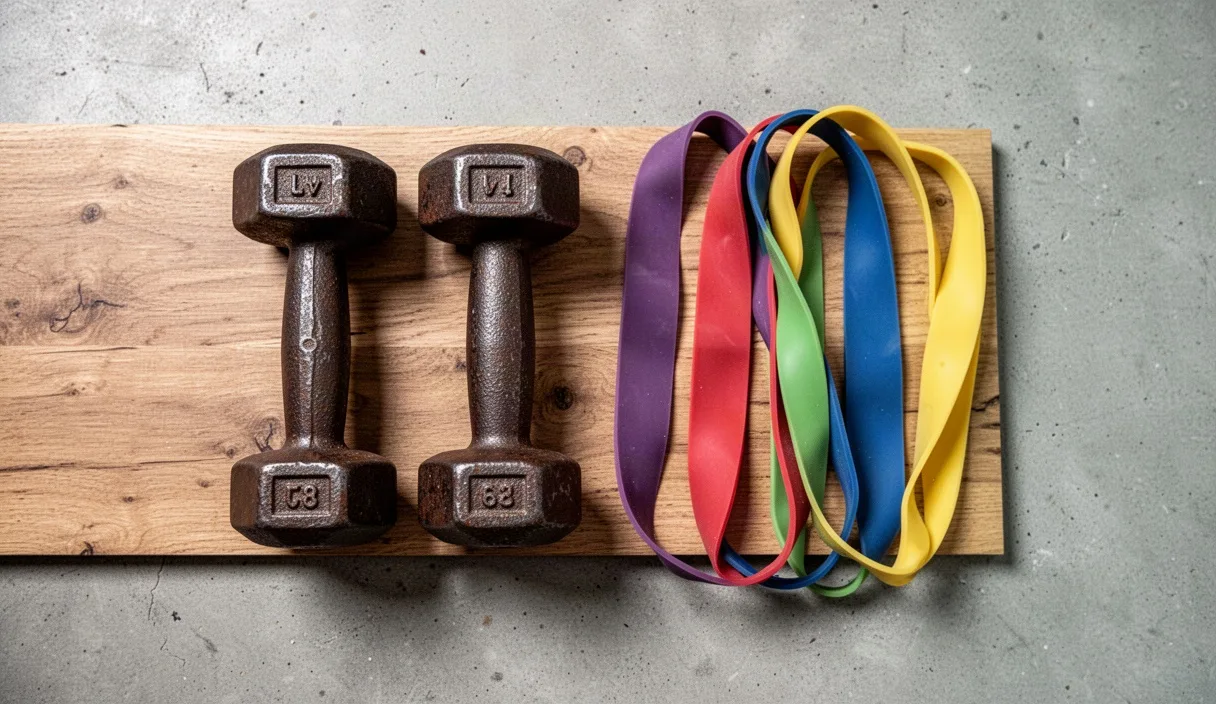
Muscle tissue does not identify the tool in your hands. It registers mechanical tension, motor unit recruitment, and the metabolic demands of skeletal muscle contraction. Free weights use metal plates and gravity to apply a downward load along a vertical axis. Resistance bands use layered latex or synthetic rubber to produce tension through elastic deformation. Both tools can stimulate muscle protein synthesis and promote hypertrophy when sets are taken within two to three repetitions of muscular failure.
The difference lies in how each tool distributes that tension across a joint path. Free weights impose a load governed by leverage, moment arms, and gravitational pull. Elastic bands impose a load governed by material thickness and the distance the band is stretched. Understanding these differences allows a lifter to select the right implement for a specific muscle group, joint condition, or training environment.
The physics of gravity versus elastic resistance
A dumbbell applies force in a single direction. Gravity pulls the mass toward the floor. If you hold a twenty-kilogram dumbbell, the vertical force on your hand remains twenty kilograms at the bottom, middle, and top of the movement. The effort your muscles exert changes only because the length of the moment arm changes relative to your joints. Furthermore, free weights possess inertia. When you accelerate a dumbbell off your chest quickly, momentum takes over part of the work in the middle of the stroke. You must then decelerate that mass at the top to protect the joint.
Elastic resistance operates on Hooke's law of elasticity. The tension produced equals the stiffness of the material multiplied by the distance it is stretched. A forty-one-inch layered latex loop band provides minimal tension when it is slack and maximum tension at full extension. Inertia plays almost no role in band training. You cannot throw a band or let momentum carry the load upward. The material resists every centimeter of movement and actively attempts to pull your limb back toward the anchor point throughout the eccentric phase.
The direction of resistance also differs. Free weights require you to position your body so that the target muscle opposes gravity vertically. To work the pectoral muscles with a dumbbell, you must lie flat on a bench. Bands do not rely on gravity. You can anchor a band to a doorframe, a vertical post, or your own foot. This allows horizontal, diagonal, and rotational force vectors that free weights cannot replicate without a cable pulley system.
| Mechanical Factor | Free Weights (Dumbbells and Barbells) | Resistance Bands (Layered Latex) |
|---|---|---|
| Force Vector | Strictly vertical toward the ground | Direction of the anchor point |
| Inertia and Momentum | High; load can be accelerated | Near zero; tension matches elongation |
| Tension at Start of Repetition | Full nominal load instantly | Low or negligible until stretched |
| Tension at End of Repetition | Constant nominal load; varied moment arm | Peak resistance at maximum stretch |
| Eccentric Control Requirement | Lifter resists gravity | Lifter actively resists elastic recoil |
Strength curve differences in compound movements
Every multi-joint exercise has a strength curve: ascending, descending, or bell-shaped. An ascending strength curve means you are mechanically stronger near the end of the range of motion than at the start. The barbell squat, the leg press, and the flat bench press are ascending movements. You are weakest at the bottom, where your joints are in deep flexion, and strongest near the lockout, where skeletal alignment provides leverage.
Free weights challenge the weakest point of an ascending strength curve. In a barbell squat, the deepest point in the hole creates the longest moment arms across the hip and knee joints. If you fail a repetition, you fail at the bottom. Once you pass the sticking point, the effective load feels lighter because your joints have better mechanical advantages. However, the muscle fibers do not experience peak mechanical tension during the final third of the movement.
Resistance bands match an ascending strength curve directly. As you stand up out of a squat or press out of a bench press, the band elongates. The resistance increases as your mechanical leverage improves. This keeps high mechanical tension on the muscle fibers all the way to terminal extension. You cannot coast through the lockout.
This dynamic presents a trade-off for hypertrophy. Research into muscle growth shows that mechanical tension applied while a muscle is in a lengthened or stretched position generates a strong stimulus for hypertrophy. Free weights load the stretched position heavily. Bands unload the stretched position because the latex is at its shortest length. A lifter relying solely on bands must use deliberate pre-stretch, wider stances, or specific anchoring methods to ensure tension does not disappear at the bottom of the movement.
Joint stress comparison in the overhead press
The standing overhead press demonstrates how these mechanical differences affect joint wear. In the bottom position of a dumbbell press, the elbows are flexed, the hands sit near the clavicles, and the anterior deltoid must overcome the dead weight of the dumbbell. This starting position places peak shear stress on the rotator cuff and the glenohumeral joint capsule. Lifters with subacromial impingement, labral tears, or acromioclavicular joint wear often report pain during the first fifteen centimeters of the press.
A looped resistance band alters the joint stress profile entirely:
- Start Position (Clavicle Level): The band is stretched only by the distance from the feet to the shoulders. The load on the rotator cuff is minimal, allowing the lifter to set the shoulder blades without fighting a heavy downward force.
- Mid-Path (Eye Level): Tension rises progressively as the elbows extend. The deltoids and triceps take over the load as the joint moves out of the vulnerable impingement zone.
- Lockout (Overhead): The band reaches maximum extension. The deltoids, upper trapezius, and triceps contract against peak resistance at the exact moment the skeletal structure is fully stacked and stable.
For an athlete managing shoulder irritation, bands allow overhead pressing volume that would cause inflammation with iron weights. The trade-off remains the loss of bottom-range tension. Dumbbells build greater strength and mass in the deep stretched position of the deltoid. Bands build terminal lockout strength and high peak contractions while sparing the connective tissues in the bottom pocket of the press.
Cost, storage, and travel practicality
A functional home setup for free weights requires significant floor space, floor reinforcement, and capital. A set of cast-iron dumbbells ranging from five kilograms to thirty kilograms in two-and-a-half-kilogram increments totals twenty-two individual weights. That collection weighs over three hundred kilograms, takes up two meters of wall space on a commercial rack, and costs between seven hundred and twelve hundred dollars depending on the steel quality and coating.
A full commercial set of forty-one-inch layered latex loop bands covers an equivalent resistance range from two kilograms to seventy kilograms across four to six band widths:
- Thirteen-millimeter band: Two to fifteen kilograms of resistance. Used for rear deltoids, rotator cuff warm-ups, and triceps pressdowns.
- Twenty-two-millimeter band: Ten to twenty-five kilograms of resistance. Used for bicep curls, overhead presses, and chest flyes.
- Thirty-two-millimeter band: Fifteen to thirty-eight kilograms of resistance. Used for bent-over rows, front squats, and Romanian deadlifts.
- Forty-four-millimeter band: Twenty-five to fifty-eight kilograms of resistance. Used for heavy squats, good mornings, and deadlifts.
The entire band set weighs roughly two kilograms, fits inside a small gym bag, and costs between sixty and one hundred dollars. For travel, bands are unmatched. A lifter can secure thirty kilograms of variable resistance inside a carry-on suitcase without exceeding airline baggage allowances.
Durability favors cast iron. A steel dumbbell will last fifty years if kept dry. Latex bands degrade under specific conditions. Ultraviolet sunlight dries out the elastomer, leading to micro-tears. Contact with sharp edges, rough concrete, or shoe treads with coarse patterns can notch the edges of the rubber. A notched band under high tension will snap. Most dedicated lifters must replace their primary training bands every eighteen to twenty-four months to maintain safety and consistent tension.
Combining bands and dumbbells in a single weekly routine
The most effective strategy does not pick one tool over the other. It pairs the high stretched-position tension of dumbbells with the progressive lockout tension of resistance bands. This routine uses a four-day upper and lower split designed to maximize hypertrophy across both resistance profiles.
Upper Day A
- Flat Dumbbell Bench Press: Lower the weights slowly over three seconds to maximize tension in the stretched pectoral fibers. Perform 3 sets of 8 to 10 repetitions. Rest two minutes.
- Banded Standing Low Row: Anchor a thirty-two-millimeter band to a post at shin height. Pull toward the hips, holding the peak contraction for two full seconds. Perform 4 sets of 12 to 15 repetitions. Rest ninety seconds.
- Dumbbell Seated Overhead Press: Use a controlled cadence to preserve the anterior deltoid. Perform 3 sets of 8 to 10 repetitions. Rest two minutes.
- Banded Overhead Triceps Extension: Stand on the inside of a twenty-two-millimeter band and press upward. Lock out the elbows fully against the elastic peak. Perform 3 sets of 15 repetitions. Rest sixty seconds.
Lower Day A
- Dumbbell Romanian Deadlift: Focus on the deep hamstring stretch at the bottom of the movement. Perform 4 sets of 8 to 10 repetitions. Rest two minutes.
- Banded Goblet Squat: Loop a twenty-two-millimeter band under the midfoot and over the upper traps while holding a twenty-kilogram dumbbell at the chest. This combines a constant mass with rising band tension at the top. Perform 3 sets of 10 to 12 repetitions. Rest two minutes.
- Dumbbell Walking Lunge: Step forward with a vertical torso. Perform 3 sets of 12 steps per leg. Rest ninety seconds.
- Banded Lying Leg Curl: Anchor a band to a sturdy post and loop it around both ankles while lying prone on a flat mat. Perform 4 sets of 15 to 20 repetitions. Rest sixty seconds.
Upper Day B
- Banded Incline Push-Up: Wrap a twenty-two-millimeter band across the upper back, gripping the ends in the palms. Perform 3 sets of 12 to 15 repetitions. Rest ninety seconds.
- Dumbbell Chest-Supported Row: Lie chest-down on an incline bench to isolate the mid-back without spinal loading. Perform 4 sets of 10 to 12 repetitions. Rest ninety seconds.
- Dumbbell Lateral Raise: Raise the weights to shoulder height with a one-second pause. Perform 4 sets of 12 to 15 repetitions. Rest sixty seconds.
- Banded Hammer Curl: Stand on a twenty-two-millimeter band and grip the rubber with a neutral wrist. Squeeze the brachioradialis at full flexion. Perform 3 sets of 15 repetitions. Rest sixty seconds.
Lower Day B
- Dumbbell Bulgarian Split Squat: Place the rear foot on a bench. Descend until the back knee hovers two centimeters off the ground. Perform 3 sets of 8 to 10 repetitions per leg. Rest two minutes.
- Banded Good Morning: Stand on a thirty-two-millimeter band, loop the other end behind the neck, and hinge at the hips to load the posterior chain. Perform 4 sets of 12 to 15 repetitions. Rest ninety seconds.
- Dumbbell Calf Raise: Stand on the edge of a step with one dumbbell in hand for balance and load. Perform 4 sets of 12 to 15 repetitions with a two-second stretch at the bottom. Rest sixty seconds.
Common mistakes
- Allowing the band to snap back on the eccentric stroke: The eccentric phase accounts for a substantial portion of the hypertrophy stimulus. When using bands, many lifters push hard on the way out and let the rubber whip them back to the start. You must actively control the return over a two-to-three-second count.
- Tracking progress by band color instead of measured distance: Band colors vary by manufacturer and lose elasticity over time. Stepping five centimeters further away from the anchor point can alter the resistance by four to six kilograms. Mark your foot placement on the floor with tape to ensure progressive overload is genuine.
- Anchoring bands to unstable furniture: Anchoring a heavy band to a lightweight bed frame or a hollow interior door can dislodge the anchor, break the door, or snap the band back toward your face. Always use dedicated door anchors placed on the frame side of a closed exterior door, or secure the bands to solid steel uprights.
- Neglecting stretch-mediated hypertrophy: Relying exclusively on bands for chest and hamstring exercises often leaves the muscles under-stimulated in the lengthened position. If you have only bands, step further back from the anchor to maintain baseline tension even when your limbs are at full joint extension.
Practical next steps
Audit your current training space and physical tolerances. If you suffer from chronic shoulder or elbow pain during the turnover of pressing movements, substitute your heavy pressing with banded presses for six weeks. This keeps the triceps and deltoids active while dropping joint shear at the turnaround point.
Purchase a standard four-pack of layered latex loop bands containing thirteen, twenty-two, thirty-two, and forty-four-millimeter widths, along with a padded door anchor. If you currently train with dumbbells, add bands to your accessories first: use them for face pulls, triceps extensions, and terminal knee extensions. If joint pain persists beyond two weeks of modified training, consult a licensed physical therapist or orthopedic specialist to assess your joint mechanics before loading those patterns further.